

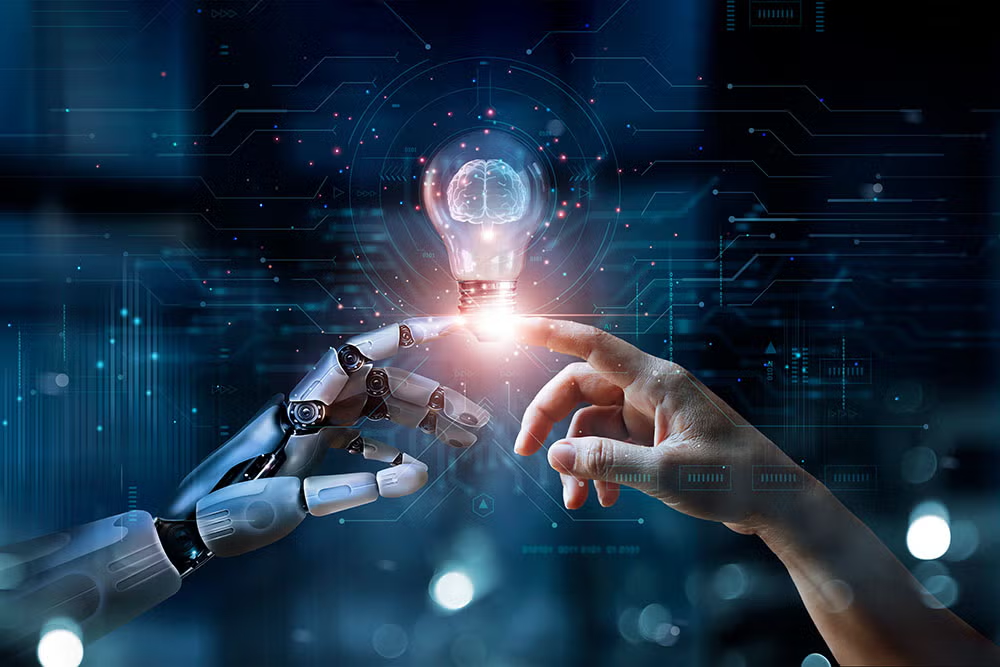
Will AI Replace Human Creativity in 2026? Discover how AI is transforming creativity, jobs, and human imagination

The big question everyone is asking today is: Will AI Replace Human Creativity in 2026?Walk into any design studio, marketing agency, or even a solo creator’s workspace in 2026, and you’ll notice something different. It’s not just sketchbooks, cameras, or laptops anymore—it’s dashboards filled with prompts, outputs, and iterations powered by generative AI creativity models.
This shift has sparked one of the most debated questions of our time: Will AI replace human creativity?
The answer isn’t as simple as “yes” or “no.” Creativity isn’t just about producing content—it’s about meaning, context, emotion, and connection. While machine learning art generation and AI-assisted design tools are evolving at an astonishing pace, they operate very differently from the way humans create.
What we’re witnessing isn’t a replacement—it’s a transformation. And to understand where things are heading, we need to explore how AI and human creativity intersect, compete, and ultimately reshape each other.
The Rise of AI Creativity: Power, Speed, and Scale

Will AI Replace Human Creativity in 2026? Understanding the Rise of AI Creativity.In the last few years, deep learning neural networks in art have gone from experimental tools to mainstream creative engines. AI can now generate illustrations, compose music, write scripts, and even simulate entire personalities through synthetic media and AI influencers.
AI’s Strength: Scale and Efficiency
One of the biggest advantages of AI lies in AI-driven content scalability. A single prompt can generate hundreds of variations in seconds—something no human can match. This has led to widespread creative workflow automation, especially in industries like marketing and media.
For example:
- Brands now produce personalized ad campaigns using AI personalization in creative work
- Content teams scale blogs, visuals, and social media posts rapidly
- Designers use AI-assisted design tools to speed up prototyping
This efficiency has fueled creative industry disruption (media, art, marketing). Traditional workflows are being replaced or augmented, and businesses are rethinking how creativity fits into their operations.
But Is AI Truly Creative?
Here’s where things get nuanced. AI doesn’t “create” in the human sense—it predicts. It analyzes patterns from vast datasets and recombines them. This raises the debate of originality vs algorithmic recombination.
AI excels at:
- Pattern recognition
- Style replication
- Data-driven optimization
But it struggles with:
- True novelty
- Intentional meaning
- Emotional depth
This brings us to a deeper comparison: creative problem-solving vs pattern recognition. Humans solve problems by connecting ideas in unexpected ways, often influenced by personal experiences and emotions. AI, on the other hand, relies on probabilities.
Human Creativity: Emotion, Experience, and Meaning
Will AI Replace Human Creativity in 2026 or Enhance It? The Human Creativity Advantage.While AI is fast and efficient, human creativity operates on a completely different level. It’s rooted in cognitive creativity processes, shaped by memory, culture, and lived experience.
The Power of Emotional Intelligence
One of the most significant human advantages is emotional intelligence in creativity. Whether it’s writing a story, designing a campaign, or composing music, humans create with empathy.
Think about:
- A filmmaker capturing raw human emotion
- A writer expressing grief, joy, or nostalgia
- A designer reflecting cultural identity
These elements come from personal experience in artistic expression—something AI cannot genuinely replicate.
Context Matters More Than Ever
Creativity doesn’t exist in a vacuum. It’s deeply influenced by cultural context in creativity. A piece of art or content resonates because it connects with a specific audience at a specific time.
AI can mimic cultural trends, but it doesn’t live them. This limitation ties into AI creativity limitations (lack of consciousness). Without awareness or subjective experience, AI cannot fully understand the meaning behind what it produces.
Human Intuition vs Machine Logic
Another key distinction lies in human intuition vs machine intelligence. Humans often make creative leaps that defy logic—ideas that feel right before they can be explained.
This intuition drives:
- Breakthrough innovations
- Unique storytelling
- Emotional resonance
AI, by contrast, operates within defined parameters. It’s powerful, but not instinctive.
The Middle Ground: Collaboration, Not Competition

Will AI Replace Human Creativity in 2026? The Truth About Human-AI Collaboration.Rather than replacing humans, AI is increasingly becoming a collaborator. The future of creativity lies in human-AI creative collaboration.
The Rise of Hybrid Creativity
We’re entering an era of hybrid creativity (human + AI co-creation), where humans and machines complement each other.
Examples include:
- Writers using AI for brainstorming but refining the narrative themselves
- Designers generating concepts with AI and adding human nuance
- Marketers combining AI insights with storytelling expertise
This approach blends human imagination vs computational creativity, creating outcomes that neither could achieve alone.
AI as an Augmentation Tool
This shift fuels the ongoing AI augmentation vs replacement debate. Instead of replacing creatives, AI is enhancing their capabilities.
With AI, creators can:
- Explore more ideas in less time
- Focus on strategy and storytelling
- Reduce repetitive tasks through automation
This allows humans to double down on human-centered creativity skills—skills that emphasize empathy, originality, and meaning.
Challenges and Concerns: Ethics, Authenticity, and Ownership

Will AI Replace Human Creativity in 2026? Challenges, Ethics, and Limitations.Despite its benefits, AI introduces serious challenges that can’t be ignored.
The Authenticity Problem
As AI-generated content becomes more common, questions about AI-generated content authenticity are growing.
Audiences are starting to ask:
- Is this created by a human or a machine?
- Does it matter?
This ties into the broader tension of creative authenticity vs automation. While automation increases efficiency, it can dilute the uniqueness of creative work.
Bias and Limitations
Another concern is AI bias in creative outputs. Since AI learns from existing data, it can inherit and amplify biases present in that data.
This affects:
- Representation in art and media
- Cultural narratives
- Creative diversity
Addressing these biases requires human oversight—another reason why full replacement is unlikely.
Legal and Ethical Questions
The rise of AI creativity also raises complex legal issues, including:
- Copyright and ownership of AI-generated content
- The ethical implications of AI art
- The use of copyrighted data in training models
These challenges are still evolving, and they will play a major role in shaping the future of creative industries.
The Future of Creative Work in 2026 and Beyond

Will AI Replace Human Creativity in 2026? Future Jobs and Industry Impact.So what does all this mean for creatives?
Jobs Are Changing, Not Disappearing
The future of creative jobs (AI impact) is not about elimination—it’s about transformation.
Roles are evolving to include:
- AI prompt engineers
- Creative strategists
- Hybrid designers and storytellers
Creatives who adapt and embrace AI will have a significant advantage.
A Shift in Value
As AI handles repetitive tasks, the value of human creativity will shift toward:
- Strategic thinking
- Emotional storytelling
- Cultural insight
This aligns with emerging digital creativity transformation trends 2026, where creativity is less about production and more about meaning and impact.
Quality vs Quantity
The debate of AI content quality vs human storytelling will continue to shape the industry. While AI can produce content at scale, human storytelling remains unmatched in depth and connection.
Brands and audiences are already showing a preference for authenticity over volume.
Conclusion: Who Wins—AI or Humans?
So, will AI replace human creativity in 2026?
The honest answer: No—but it will redefine it.
AI is incredibly powerful. It excels at speed, scale, and efficiency. But creativity is more than output—it’s about meaning, emotion, and human connection. And that’s where humans still lead.
The real future isn’t AI versus humans. It’s AI with humans.
The creators who thrive in 2026 and beyond will be those who:
- Embrace human-AI creative collaboration
- Focus on uniquely human strengths
- Use AI as a tool, not a replacement
In the end, creativity isn’t a competition—it’s an evolution.
FAQs
1. Can AI be truly creative or just mimic humans?
AI is not truly creative in the human sense—it primarily mimics and recombines existing data patterns. Using advanced algorithms and large datasets, AI can generate impressive outputs, but it lacks intent, consciousness, and emotional experience. Human creativity involves imagination, intuition, and meaning-making, while AI relies on probability and pattern recognition. So, AI can simulate creativity, but it doesn’t genuinely “create” like humans do.
2. Will AI replace artists, writers, and designers?
AI is unlikely to fully replace creative professionals, but it will transform how they work. Artists, writers, and designers who adopt AI tools can work faster and explore more ideas. However, human skills like storytelling, emotional connection, and cultural understanding remain essential. Instead of replacement, the future points toward collaboration between humans and AI.
3. What are the limitations of AI creativity?
AI creativity has several key limitations:
- It lacks emotional intelligence and personal experience
- It depends on existing data, limiting true originality
- It struggles with deep meaning and context
- It can produce biased or inaccurate outputs
- It has no self-awareness or intent
These limitations mean AI can assist creativity but cannot fully replace human imagination.
4. Is AI-generated content copyright protected?
In many countries, AI-generated content is not fully copyright protected unless there is significant human involvement. Legal systems often require a human author for copyright ownership. This means creators using AI should add original input, editing, or direction to ensure legal protection. Laws are still evolving, so this area remains uncertain.
5. How can creators stay relevant in the AI era?
To stay competitive, creators should:
- Learn how to use AI as a tool, not a replacement
- Focus on original ideas, storytelling, and emotional depth
- Build a strong personal brand and unique voice
- Develop skills like creative direction and strategy
- Stay updated with AI trends and tools
The key is to combine human creativity with AI efficiency.
6. Does AI reduce originality in content?
AI can sometimes reduce originality because it relies on existing data and patterns. This can lead to repetitive or generic outputs, especially when widely used. However, when guided by humans, AI can enhance creativity by generating ideas that humans can refine and improve. The impact on originality depends on how AI is used.
7. What is the future of creative jobs with AI?
Creative jobs are evolving rather than disappearing. The future will include:
- AI-assisted roles (designers, writers, marketers)
- New roles like AI prompt engineers and creative strategists
- Increased demand for high-level creative thinking and storytelling
Routine tasks may be automated, but human creativity will remain valuable in shaping ideas and meaning.
8. Can AI outperform professional creatives?
AI can outperform humans in speed, efficiency, and volume, especially for repetitive or data-driven tasks. However, top professional creatives still outperform AI in:
- Original thinking
- Emotional storytelling
- Cultural relevance
AI may match or exceed average-level work, but it struggles to compete with high-level human creativity and innovation.
